
 The Digital Monroe Doctrine: rebranding copyright infringement as a military asset
  Transformative Justice in the Syrian Transition
  Strategic Pragmatism: A New Approach to European Engagement in Africa
  Special Issue “Role of AI and Automated Decision-Making Systems in Asylum and Migration”
Written by Matteo Benedetti, Ambassador to Italy
Edited by Aurora Eberle
Keywords:
High-speed railways, TEN-T, Transport, Dual-use infrastructure, Mobility
Abstract
High-speed rail infrastructure has become a fundamental instrument in achieving European integration, representing more than just a transport-related issue. In recent years, the European Commission has integrated rail infrastructure into multiple political and administrative domains. It now plays an important role in achieving climate neutrality and in strengthening territorial cohesion between and within Member States. It is also considered crucial for enhancing the competitiveness of the single market and for reinforcing Europe’s geopolitical and security resilience. In this regard, the present review examines the European strategy and vision as articulated through the Trans-European Transport Network (TEN-T) framework. This sets out nine European Transport Corridors throughout the continent, each conceived as a segment of a system designed to connect major urban nodes, reduce short-haul air traffic, and improve cross-border mobility. The framework aims to establish a consistent model in which infrastructure across Member States shares standards, systems, and continuous corridors. Additional Communications by the Commission further refine and develop this strategy. Through these initiatives, the European Union now faces the challenge of elevating the current high-speed rail infrastructure from a mere collection of railways to a system capable of uniting Member States within a more interconnected network.
The EU Vision: Strategic Infrastructure within the TEN-T Framework
High-speed rail infrastructure is a key component to be harmonised and integrated within the broader European transport system. Where aviation is inefficient or unsuitable, high-speed rail provides a suitable alternative. It operates at a different layer of the overall system and can reduce emissions, strengthen territorial cohesion, and transport goods and people where aviation and maritime transport are less effective and efficient. It is also increasingly relevant from a security perspective, which has become crucial in recent years, given the ongoing conflicts near the EU’s borders. However, despite its strategic importance, high-speed rail infrastructure still faces significant challenges related to fragmentation across national systems. For this reason, its continued evolution and integration at the European level are essential to fully realise its potential.
To achieve this, the European Union’s effort to legislate and to develop an operational plan has been built on a layered policy architecture that continues to evolve. The TEN-T framework provides the regulatory layer and serves as the binding legal foundation on which the EU’s overall endeavour is based. As a Regulation, it establishes mandatory standards, corridor structures, and implementation milestones for Member States. It sets three different and sequential legally relevant targets for 2030, 2040 and 2050, progressively expanding the framework’s network. Following this regulatory backbone, Communications adopted by the European Commission provide further indications regarding the strategic direction and the political priorities, thereby guiding subsequent operational actions.
The Action Plan to Boost Long-Distance and Cross-Border Passenger Rail (Directorate-General for Mobility and Transport, 2021) frames rail infrastructure as a key instrument for achieving the objectives of the European Green Deal. It also addresses longstanding structural barriers, including regulatory fragmentation, limited interoperability, and insufficient cross-border coordination. Despite its potential, the European rail system remains underutilised, particularly in cross-border services. Within this context, high-speed rail infrastructure is presented as a central instrument for reducing greenhouse gas emissions and for improving the overall efficiency and integration of the European transport system. According to the European Environment Agency (2025), rail transport accounts for less than 0.5% of transport-related greenhouse gas emissions in the EU, while significantly outperforming aviation in terms of emissions per passenger-kilometre.
The Communication Connecting Europe through High-Speed Rail (Directorate-General for Communication, 2025) further develops the ambitions of the TEN-T framework. Although it remains a non-binding policy document, it reinforces the TEN-T strategy through a stronger acceleration agenda aimed at addressing persistent fragmentation and delays in the development of cross-border infrastructure. It emphasises governance coordination, interoperability, and the mobilisation of investment as key conditions for the effective delivery of an integrated network. The Communication also highlights the need to ensure competitive cross-border journey times, positioning high-speed rail as a viable alternative to short-haul aviation. Additionally, it frames high-speed rail as a strategic asset contributing to the Union’s broader objectives of integration, resilience, and strategic autonomy.
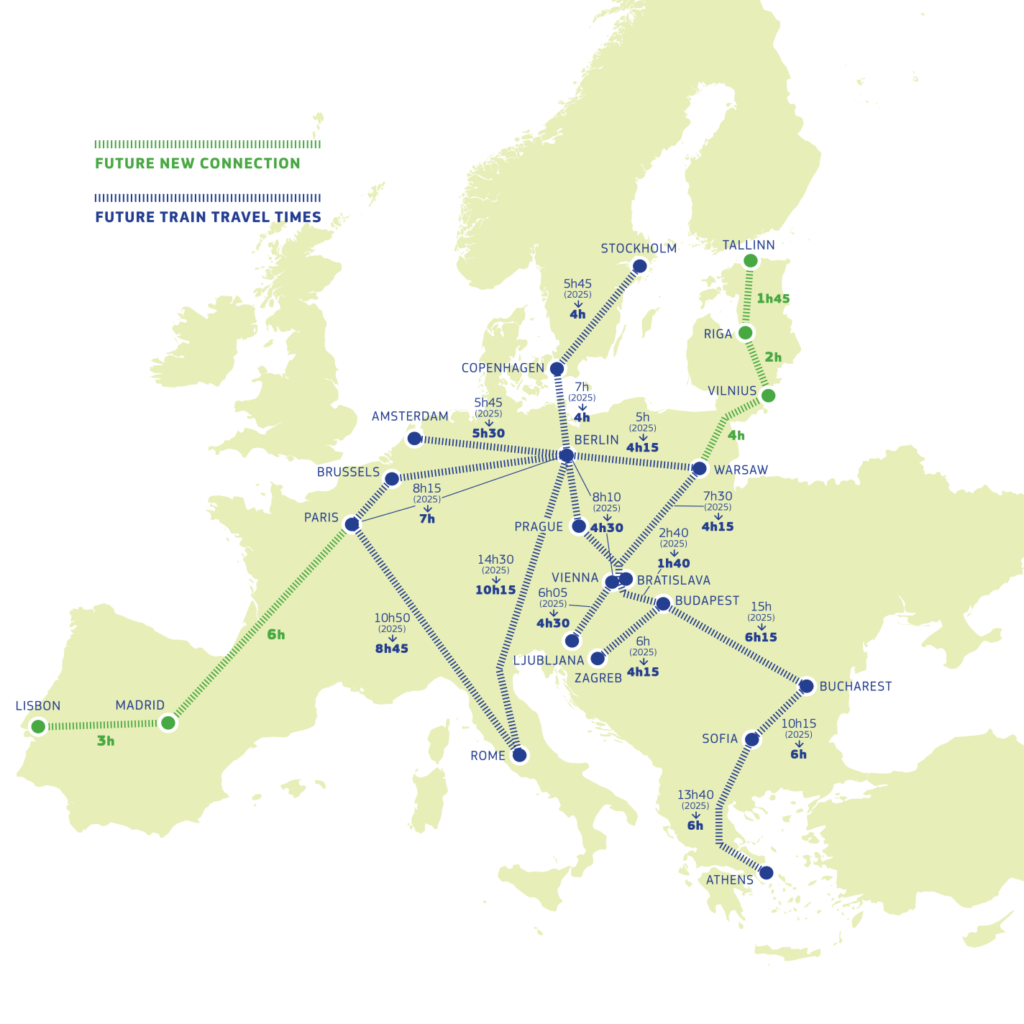
Figure 1
Future high-speed rail connections and projected travel times across Europe under the TEN-T framework (DG Move: 2025, November 5).
However, beyond mobility efficiency, the EU has increasingly recognised the strategic value of high-speed rail. It is now linked not only to territorial cohesion and resilience, but also to the Union’s capacity to maintain connectivity and respond effectively in times of crisis.
With the Joint communication to the European Parliament and the Council: Action plan on military mobility (European Commission & High Representative, 2018), military requirements began to be more closely aligned with the TEN-T framework, highlighting the dual-use potential of parts of the civilian transport infrastructure. This shift is reflected more clearly in the revised TEN-T Regulation (Regulation (EU) 2024/1679), which integrates military mobility requirements into the network’s development and emphasises interoperability, coordinated investment, and seamless movement as strategic objectives rather than merely technical ones. The Joint communication to the European Parliament and the Council on Military Mobility (European Commission & High Representative, 2025) further elevates military mobility from a complementary objective to an increasingly urgent strategic priority.
The Structural Policy Gap
Even though the European Union has clarified its vision, important implementation challenges remain. In particular, the EU should address the mismatch between its project and the various national political systems responsible for implementing frameworks and communications. High-speed rail is envisaged as an integrated European network, yet infrastructure development remains shaped by domestic political priorities, economic concerns, and electoral cycles. As a result, the risk lies not in a lack of investment, but rather in the fragmented national strategies.
The most recent reports from the European Court of Auditors (2026) have identified ongoing delays in the implementation of TEN-T core network projects, as well as weaknesses in cross-border coordination, and ineffective existing control mechanisms, which risk compromising the achievement of the 2030 milestones. At the European level, high-speed rail is conceived and discussed as a logic of networks, with corridors, interoperability, cross-border coordination, and harmonisation. On the contrary, at the national level, projects often take the form of stand-alone investments, justified by internal mobility needs or, at times, by political considerations.
A revealing example is the project for the construction of the Bridge over the Strait of Messina. Although it forms part of the Scandinavian-Mediterranean corridor, it has been highly politicised and its realisation largely depends on domestic political dynamics, rather than on the TEN-T framework.
A further factor that reinforces this policy gap is the increased awareness of infrastructure as a strategic asset. Recent policy developments have sought to establish a direct connection between the Trans-European Transport Network and security and resilience objectives. The 2018 Joint communication to the European Parliament and the Council: Action plan on military mobility (European Commission & High Representative, 2018) and the 2022 Joint communication to the European Parliament and the Council on military mobility 2.0 (European Commission & High Representative, 2022) increasingly incorporated strategic mobility into EU transport policy, recognizing the relevance of civilian infrastructure to military mobility and security. This is further reflected in the revised TEN-T Regulation (Regulation (EU) 2024/1679), which requires Member States to adopt a coherent and cohesive approach on this matter.
Overall, the obstacles do not lie in the decision of whether to invest or not. The real obstacle lies in whether the European Union will be able to transform a collection of national rail projects into a coherent European system capable of delivering on its promises of cohesion, sustainability, and strategic autonomy.
Why Coherence Matters
Thus, the coherence of the European high-speed rail strategy is not merely a technical issue; it also constitutes a political and strategic imperative. The infrastructure has significant implications for the future of European economic development, territory, and integration. The consequences of an insufficiently integrated high-speed rail network extend beyond transport efficiency.
First, territorial cohesion remains a core objective. The TEN-T framework was designed to address existing disparities by integrating peripheral areas into the continent as a functioning network. However, if investment priorities are skewed towards areas that are already relatively well-connected to the rest of the European territory, the high-speed rail network may contribute to the perpetuation of existing disparities rather than mitigate them. Developments in Genoa highlight the potential of the framework to integrate a city and its infrastructure into the broader network. The Third Giovi Pass is designed to connect the city and its port to the Milan node passing through the Apennines. This will increase the efficiency and freight capacity of Genoa’s infrastructure, realize the TEN-T vision and objectives, and revitalise a city and its economic system.
Second, competitiveness and market integration are directly affected. A competitive European economy depends on predictable and compatible transport systems. An unintegrated high-speed rail network undermines the very rationale of cross-border transport.
Third, resilience and strategic autonomy in the context of transport infrastructure have emerged as a crucial element. Recent geopolitical developments have made it increasingly necessary to have transport infrastructure that is secure and flexible. The high-speed rail network, as part of the TEN-T network, has the potential to make European territory more internally connected in times of crisis, thus avoiding the need to rely on less secure external transport routes.
Finally, the issue of credibility arises. If the European Union is to present the high-speed rail network as the backbone of European integration, while at the same time misalignments in its implementation persist, it would undermine its credibility in infrastructure policies.
Building Integration in Concrete and Steel
Beyond the question of governance, an additional strategic dimension can be considered. A more cohesive and extended high-speed rail network would not only increase sustainability, resilience, and competitiveness, but would also significantly tie Member States closer together through the physical infrastructure they share. Indeed, integrated transport corridors can generate strong patterns of interdependence among Member States, as economic flows, mobility systems, and logistics can become increasingly intertwined.
Therefore, a fully functioning, interoperable, and strategically aligned high-speed rail network can become a powerful tool for making the Union more indispensable. As infrastructural interconnections among Member States increase, so does their mutual dependence. This growing interdependence can, in turn, reinforce unity and reduce the feasibility of disintegration.
High-speed rail will certainly leave a significant mark on Europe’s territory and economy, and the question is no longer whether it should be developed, but how it can be developed in a way that effectively enhances cohesion, resilience, and the structural bonds of integration among Member States.
From Infrastructure to Integration
This review examines the evolving role of high-speed rail infrastructure, highlighting its growing significance as a strategic component of European integration. The European Union has developed a vision that is ambitious and increasingly coherent within the TEN-T framework, which recognises that the issue of infrastructure is not a technically neutral notion, but rather one that is integrally linked to the concept of integration. The effectiveness of this vision depends on Member states’ alignment. The key challenge is not merely financial or technical, but rather a fundamentally political one: how to transform the issue of infrastructure into a genuinely European concept. This requires the active engagement of national governments, regional planners, and funding agencies within a context of shared accountability and endeavour. The future of high-speed rail in Europe will not be defined by speed alone, but by its capacity to translate strategic objectives into sustained and coordinated action.
Use of AI tools:
I used AI tools to help me by correcting the grammar and finding synonyms, improving fluency and replacing terms not suitable for a review of this kind.
Bibliography
Directorate-General for Mobility and Transport. (2021, December 14). Action Plan to Boost Long-Distance and Cross-Border Passenger Rail. European Commission.
https://transport.ec.europa.eu/news-events/news/action-plan-boost-passenger-rail-2021-12-14_en
Directorate-General for Communication. (2025, November 5). Connecting Europe Through High-Speed Rail. European Commission.
https://transport.ec.europa.eu/document/download/774e79c9-1ece-4514-8f16-a2b98049c82e_en
European Commission & High Representative of the Union for Foreign Affairs and Security Policy. (2018). Joint Communication to the European Parliament and the Council: Action Plan on Military Mobility (Join(2018) 5 final). https://eur-lex.europa.eu/legal-content/EN/TXT/PDF/?uri=CELEX:52018JC0005
European Commission & High Representative of the Union for Foreign Affairs and Security Policy. (2022). Joint Communication to the European Parliament and the Council on Military Mobility 2.0 (Join (2022) 48 final). https://eur-lex.europa.eu/legal-content/EN/TXT/PDF/?uri=CELEX:52022JC0048
European Commission & High Representative of the Union for Foreign Affairs and Security Policy. (2025). Joint Communication to the European Parliament and the Council on Military Mobility (Join (2025) 846 final). https://defence-industry-space.ec.europa.eu/document/download/c3d3067c-6d9a-4f95-9a69-4dd99c340188_en?filename=Action%20plan%20on%20military%20mobility%202.0.pdf
European Court of Auditors. (2026). EU Transport Infrastructure: Persistent Delays and Coordination Weaknesses in the TEN-T Core Network (Special Report 02/2026). https://www.eca.europa.eu/ECAPublications/SR-2026-02/SR-2026-02_EN.pdf
European Environment Agency. (2025). Greenhouse Gas Emissions from Transport in Europe .
https://www.eea.europa.eu/en/analysis/indicators/greenhouse-gas-emissions-from-transport
European Union. (2024). Regulation (EU) 2024/1679 on Union Guidelines for the Development of the Trans-European Transport Network . https://eur-lex.europa.eu/legal-content/EN/TXT/PDF/?uri=OJ:L_202401679