 EU-Mercosur and CAP Reform: the search for European competitiveness
  Reprogramming Equality: Decoding the Algorithm of the EU’s AI Act
  Bridging Continents: A Comparative Study of China and the EU’s Engagement in the Inner Maghreb
  A Catastrophe for Generations: The Production of Debility during the Genocide in Gaza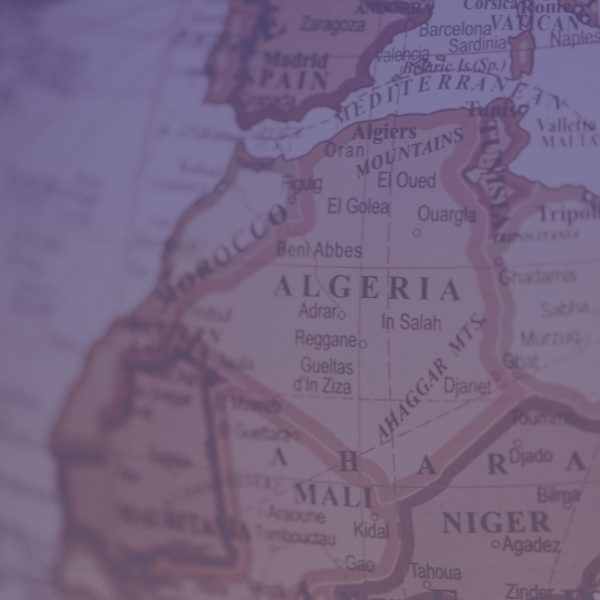
Written by Gracia María Pérez Vico
(Ambassador to Spain, gracia_maria.perez_vico@esthinktank.com)
Introduction
The Inner Maghreb, comprising Algeria, Tunisia, and Morocco, has long occupied a strategic position at the crossroads of Europe, Africa, and the Mediterranean. In recent years, the region has re-emerged as a focal point of international geopolitical interest, particularly for the European Union (EU) and the People’s Republic of China. This renewed attention is most clearly expressed through infrastructure investment, which has become a central instrument for projecting influence, fostering economic ties, and shaping long-term development trajectories. As global competition increasingly unfolds through connectivity initiatives and economic statecraft rather than military confrontation, infrastructure has gained prominence as a strategic and political tool rather than a purely technical or economic one.
The EU has historically maintained a strong presence in the Inner Maghreb through frameworks such as the European Neighbourhood Policy (ENP), the Union for the Mediterranean (UfM), and more recently the Global Gateway. Through these instruments, the Union seeks to promote regional integration, sustainable development, and economic convergence, while advancing values related to good governance, institutional reform, and environmental and social standards. In parallel, China has significantly expanded its engagement in the region under the Belt and Road Initiative (BRI), investing in ports, transport networks, energy infrastructure, and industrial zones. China’s approach emphasizes state-led development, financial pragmatism, and the principle of non-interference in domestic political affairs, offering an alternative model of development cooperation that appeals to governments seeking rapid infrastructure delivery without political conditionalities.
The simultaneous presence of the EU and China in the Inner Maghreb has generated considerable debate among scholars and policymakers. Dominant policy discourses tend to frame EU-China relations through the lens of systemic rivalry, assuming that their development models, normative frameworks, and strategic objectives are fundamentally incompatible. According to this view, China’s growing economic footprint is often portrayed as undermining the EU’s influence and challenging its normative agenda in the region. However, this thesis questions the adequacy of such a binary interpretation. While competition between the two actors is undeniable, it argues that their coexistence in the Inner Maghreb also reveals areas of overlap, parallelism, and potential complementarity, particularly in infrastructure sectors where both prioritize connectivity, economic development, and regional stability.
The relevance of this research is heightened by transformations in the international system, where power is increasingly exercised through economic instruments, connectivity initiatives, and norm diffusion. In this context, both the EU and China can be understood as engaging in what Schumacher (2017) described as “milieu-shaping” based on “milieu” developed by Wolfers (1962): attempts to structure their external environment in ways that align with their interests and worldviews. The EU’s approach is rooted in a rules-based and multilateral logic, emphasizing sustainability, transparency, and institutional reform. China, by contrast, advances a model centred on infrastructure-led growth, state sovereignty, and flexible financing arrangements. The Inner Maghreb constitutes a particularly revealing arena for observing these dynamics, given its political diversity, development needs, and strategic importance for both actors.
Despite a growing body of literature on the BRI and on EU relations with the Southern Mediterranean, relatively few studies have conducted a systematic comparative analysis of how the EU and China operate within the same local contexts, especially in the field of infrastructure investment. Moreover, while the normative dimensions of EU foreign policy have been widely discussed, often through the concept of Normative Power Europe (Manners, 2009), less attention has been paid to the possibility that China also exercises a form of normative influence, albeit grounded in different principles such as sovereignty, non-interference, and South-South cooperation rhetoric (Li and Hackenesch, 2024a). This study seeks to address these gaps by offering a comparative analysis of EU and Chinese infrastructure strategies in Morocco, Tunisia, and Algeria, focusing on how norms, interests, and strategic considerations intersect in practice.
The central research question guiding this inquiry is: What motivates China’s and the EU’s engagement in the Inner Maghreb, how do their differing strategies reflect competing or complementary visions of regional development, and what tensions or synergies emerge from their coexistence in shaping the region’s infrastructure? To answer this question, the study explores how infrastructure investments reflect broader strategic goals, the types of norms being promoted by each actor, and whether these efforts result in competition, coexistence, or complementarity on the ground. Infrastructure is therefore conceptualized as a “vector of influence”: a material expression of strategic priorities, development models, and underlying political values that shape the regional environment over time.
The thesis builds on a dual theoretical foundation combining elements of realism and constructivism. From a realist perspective, both the EU and China are viewed as engaging in strategic behaviour aimed at securing influence and access to markets and resources, using infrastructure as a geoeconomic tool. A constructivist approach complements this view by emphasizing the role of ideas, identities, and normative frameworks in shaping how these actors define and pursue their interests. While the EU explicitly presents initiatives such as the Global Gateway as values-based alternatives to the BRI (Buhigas Schubert and Costa, 2023), China’s engagement also reflects a distinct normative vision of international cooperation that resonates with certain regional preferences.
Building on this framework, the study advances two working hypotheses. First, despite prevailing narratives of systemic rivalry, EU and Chinese engagement in the Inner Maghreb may display greater normative and practical complementarity than commonly assumed, particularly in infrastructure-driven milieu-shaping. Second, China’s expanding presence under the BRI challenges the EU’s traditional economic and political influence by offering alternative development pathways, prompting the Union to adapt and recalibrate its strategies.
Methodologically, the research adopts a comparative case study approach focusing on Morocco, Tunisia, and Algeria. These cases are selected for both their relevance and their diversity in terms of engagement with the EU and China, allowing for the identification of broader trends, tensions, and possible areas of convergence. The analysis concentrates on infrastructure-related sectors between 2003, the launch of the ENP, and the present, capturing the evolution of EU and Chinese strategies within a comparable timeframe.
Literature Review
The perception of China as a competitor or antagonist to the EU has become increasingly prominent in both policy and academic debates. This framing was institutionalized in the EU’s Joint Communication (European Commission and High Representative, 2019), which labelled China a “systemic rival,” (p.1) marking a turning point in EU-China relations. A substantial body of literature has since reinforced this rivalry narrative, portraying China’s growing global footprint, particularly through the BRI, as a challenge to the EU’s economic interests, normative agenda, and geopolitical influence. Scholars such as Blockmans and Hu (2019), Oertel (2020), Small (2025), and the European Court of Auditors (2020) emphasize systemic competition, while others extend this analysis to Africa (Karkare et al., 2020; Men and Barton, 2011b; Tull, 2008) and North Africa (Esteban and Armanini, 2022; Vogl, 2021; Ghafar and Jacobs, 2020; Zhang and Xiao, 2022; Tran and Zoubir, 2022), arguing that China’s infrastructure-led engagement undermines the EU’s traditional role as a leading development and governance actor.
A second strand of literature nuances this rivalry narrative by highlighting internal divisions within the EU and the complexity of its perceptions of China (Zhang, 2020; Miskimmon et al., 2020b; Hooijmaijers, 2021; Miskimmon et al., 2020a; Miskimmon and O’Loughlin, 2020). From this perspective, the EU-China relationship is best understood as multifaceted rather than antagonistic, shaped by pragmatic considerations, domestic political dynamics, and shifting geopolitical priorities. This literature also underscores that China perceives the EU as a rival in governance and influence (Shikwati et al., 2022), particularly in regions where both actors pursue overlapping economic and strategic objectives.
A third body of scholarship moves beyond rivalry to explore the potential for complementarity and cooperation between the EU and China (Miskimmon et al., 2020a), especially in Africa. Authors such as Stahl (2022), Karkare et al. (2020), Tull (2008), Fioramonti and Kimunguyi (2011) and Ogunleye (2011) argue that despite differing institutional frameworks and normative discourses, both actors share interests in Africa. Studies on EU-China-Africa trilateral cooperation suggest that while such initiatives have largely failed to materialize, they have nonetheless reduced antagonism and revealed overlapping priorities (Hooijimaijers, 2021). Other scholars like Lirong (2011) contend that the EU’s self-image as a normative power often masks its own strategic and economic motivations, bringing its approach closer to China’s pragmatism than commonly acknowledged.
Despite these insights, the existing literature exhibits two notable gaps. First, while rivalry and cooperation have been debated, few studies systematically compare how the EU and China operate within the same local contexts, particularly in infrastructure-related sectors. Second, research on North Africa, and especially the Inner Maghreb, remains underdeveloped compared to broader analyses of sub-Saharan Africa. This thesis addresses these gaps by comparatively analysing EU and Chinese infrastructure engagement in Morocco, Tunisia, and Algeria, directly linking debates on rivalry and complementarity to empirical evidence from a strategically contested regional setting. It challenges the prevailing scholarly assumption that China and the EU pursue fundamentally different approaches to norm promotion and regional milieu shaping in the region.
Methodology & Methods
This study adopts a qualitative, comparative case study approach to analyse how the EU and China engage in the Inner Maghreb and how their infrastructure investments shape the regional environment. The research focuses on Morocco, Tunisia, and Algeria, three countries that are central to EU neighbourhood policies and increasingly relevant for China’s BRI. Together, they provide a suitable empirical setting to observe patterns of competition, coexistence, and potential complementarity between the two actors.
The analytical framework combines two key concepts, “milieu-shaping” (Schumacher, 2017) and normative power (Manners, 2009; Li and Hackenesch, 2024), to examine both strategic behaviour and value-driven engagement. Infrastructure investment is treated as the main empirical entry point, understood not only as an economic activity but also as a means through which external actors project influence, promote development models, and shape long-term regional dynamics.
Methodologically, the research relies on a hypothesis-testing comparative case-design (Yin, 2014; Maxwell, 2013, Levy, 2008) combined with process tracing (Collier, 2011; Schimmelfennig, 2015). The comparative approach allows for the identification of similarities and differences in EU and Chinese engagement across the three cases, while process tracing is used to reconstruct the sequence of decisions, policies, and projects that link strategic intentions to concrete outcomes. This combination makes it possible to explore not only what the EU and China do in the region, but also how and why their strategies produce particular effects.
The study follows a most-different systems design (Levy, 2008), comparing two fundamentally different actors, a supranational entity with a values-based governance model and an authoritarian state with a centralized development strategy, that nonetheless engage in the same region and sector. Infrastructure development constitutes the shared dependent variable, enabling the analysis of whether common outcomes emerge despite divergent political systems and normative foundations.
Empirically, the research draws on a combination of primary and secondary sources. Primary data include official documents issued by EU institutions and the Chinese government, which are used to analyse how each actor defines its objectives and role in the Inner Maghreb. These qualitative sources are complemented by project-level and statistical data on infrastructure investment, drawn from publicly available databases such as the China Global Investment Tracker, the European Investment Bank, and official EU and Chinese flagship initiatives. These data help link policy narratives to actual implementation on the ground.
Secondary sources including academic literature, think tank reports, and expert analyses provide contextual background and support the interpretation of empirical findings. By triangulating these different types of evidence, the study ensures analytical robustness and allows for a nuanced assessment of EU and Chinese engagement.
Overall, this methodological approach enables a clear and systematic analysis of how the EU and China pursue influence through infrastructure in the Inner Maghreb and how their interactions shape regional development trajectories.
Results / Findings
The analysis shows that infrastructure investment constitutes the central instrument through which both the EU and China pursue influence in the Inner Maghreb. Across Morocco, Tunisia, and Algeria, infrastructure operates not merely as a development tool but as a strategic vector for shaping economic trajectories, institutional alignments, and regional connectivity. While the EU and China are often portrayed as systemic rivals, the findings suggest that their engagement patterns reveal a more complex combination of competition, and selective complementarity.
1. Infrastructure as a Shared Tool of Influence
The findings demonstrate that both the EU and China rely on infrastructure to shape the regional milieu, albeit through different modalities. Ports, transport corridors, energy networks, and urban development projects serve simultaneously economic, geopolitical, and symbolic purposes. In all three countries, infrastructure investment enables external actors to embed themselves in long-term development pathways, influence regulatory environments, and consolidate strategic partnerships.
Rather than reflecting fundamentally opposed logics, EU and Chinese infrastructure initiatives converge in their underlying objectives: securing access, enhancing connectivity, and increasing long-term leverage. The main difference lies not in why they invest, but in how they structure, justify, and implement their investments.
2. China’s Engagement: From Construction to Strategic Embedding
The analysis shows that China’s infrastructure engagement in the Inner Maghreb has evolved significantly over time, moving from a contractor-driven model toward deeper economic embedding.
In Morocco, Chinese engagement has transitioned from state-led construction projects in transport and energy toward foreign direct investment in high-value sectors linked to green technology, electric mobility, and renewable energy. Early projects relied heavily on state-owned enterprises delivering physical infrastructure through bilateral agreements, with limited institutional spillovers. Since 2019, however, Chinese firms have increasingly invested in manufacturing plants, battery components, and wind technology, positioning Morocco as a regional industrial hub. The findings suggest that China now seeks long-term interdependence rather than short-term project delivery (American Enterprise Institute and Heritage Foundation, 2025).
In Tunisia, China follows a more gradual and selective trajectory. Initial involvement focused on isolated real estate and urban development projects, but recent investments in transport infrastructure indicate a shift toward longer-term capital commitment (American Enterprise Institute and Heritage Foundation, 2025). Although China’s overall footprint remains smaller than in other African contexts, the findings show a growing effort to expand presence beyond construction, combining investment, diplomacy, and symbolic projects aimed at soft power projection like the construction of the International Diplomatic Academy of Tunis (Embassy of the People’s Republic of China in the Kingdom of Norway, 2024).
In Algeria, its engagement remains strongly centred on energy, transport, and large-scale construction. Investments in oil and gas, led by companies such as CNPC and Sinopec, underline China’s priority of securing energy access. Transport and urban development projects further position Algeria as a key node within broader connectivity corridors linked to the BRI. Over time, the scale of Chinese investments has increased, signalling a shift from short-term contracts to sustained involvement in strategic sectors (American Enterprise Institute and Heritage Foundation, 2025).
Overall, the findings indicate that China adapts its infrastructure strategy to national contexts while maintaining a consistent focus on long-term economic influence, resource access, and connectivity.
3. The EU’s Engagement: From Development Aid to Geoeconomic Strategy
The analysis shows that the EU’s infrastructure engagement in the Inner Maghreb has undergone a qualitative transformation. While earlier initiatives were largely framed within traditional development cooperation, recent investments increasingly reflect geoeconomic and strategic considerations.
In Morocco, EU infrastructure policy has shifted toward green transition, resilience, and regulatory integration (Directorate-General for International Partnerships, 2024). Projects linked to renewable energy transmission, climate-resilient transport, and hydrogen development illustrate how infrastructure is used to integrate Morocco into Europe’s clean energy architecture (European Union, 2024). The findings suggest that the EU increasingly treats Morocco as a strategic partner rather than a passive aid recipient.
In Tunisia, the EU has emerged as a central actor in cross-Mediterranean energy connectivity (European Commission – GISCO, 2024). Flagship projects such as the ELMED interconnection and renewable energy programmes position Tunisia as a corridor linking North Africa and Europe (Directorate-General for International Partnerships, 2024). The findings indicate that EU investment aims to foster long-term institutional convergence while addressing energy security and decarbonisation goals.
In Algeria, EU infrastructure engagement has been more limited but is evolving. Under the Global Gateway, the EU has begun to reposition itself as a strategic partner through regional transport corridors and future-oriented energy projects such as hydrogen and electricity interconnections (Directorate-General for International Partnerships, 2024). This represents a departure from earlier reactive or humanitarian engagement.
Across the three cases, the findings suggest that EU infrastructure investment increasingly explains itself through sustainability and norms while simultaneously serving strategic autonomy, resilience, and competitiveness objectives.
4. Competition, Parallelism, and Complementarity
The findings challenge the assumption that EU-China engagement in the Inner Maghreb is inherently zero-sum. While competition is evident, particularly in visibility, standards, and geopolitical narratives, many projects operate in parallel rather than in direct opposition.
The analysis shows that Chinese speed, scale, and construction capacity contrast with the EU’s slower, regulation-heavy approach. However, these differences do not always translate into conflict. In some cases, EU financing and Chinese implementation intersect, as illustrated by infrastructure projects like the Bizerte bridge in Tunisia (European Investment Bank, 2024) where European loans support works executed by Chinese firms. Such cases demonstrate functional complementarity rather than rivalry.
Normative tensions remain, particularly regarding transparency, environmental safeguards, and governance standards. Yet the findings indicate that these tensions coexist with pragmatic cooperation, especially in sectors where both actors share material interests.
5. Milieu-Shaping and Normative Convergence
The findings suggest that both the EU and China engage in “milieu-shaping”, seeking to influence the rules, priorities, and development models of the region. The EU promotes regulatory alignment, sustainability, and institutional convergence, while China advances a model centred on sovereignty, state-led development, and infrastructure-driven growth.
However, the analysis shows that these normative frameworks are less incompatible in practice than often assumed. The EU has increasingly softened its conditionality, prioritising stability and connectivity, while China’s non-interference principle is applied flexibly through projects that generate structural transformations. As a result, both actors converge toward pragmatic engagement focused on long-term influence rather than ideological export.
6. Answering the Research Question
Taken together, the findings demonstrate that EU and Chinese engagement in the Inner Maghreb is driven by overlapping strategic motivations rather than irreconcilable normative visions. Infrastructure investment emerges as a shared instrument through which both actors seek influence, status, and economic leverage.
The analysis supports the argument that systemic rivalry does not necessarily result in clashing paths. Instead, it produces a pluralistic landscape in which competition, coexistence, and selective complementarity coexist. In this light, this region should not be viewed as a merely passive recipient of influence but rather as a laboratory of strategic pluralism and coopetition (Tran and Zoubir, 2022, p.697), where domestic actors actively engage, balance, and at times leverage the opportunities provided by both the EU and China to pursue their own development trajectories.
Bibliography
American Enterprise Institute & Heritage Foundation. (2025, January). China global investment tracker. https://www.aei.org/china-global-investment-tracker/.
Blockmans, S., & Hu, W. (2019). Systemic rivalry and balancing interests: Chinese investment meets EU law on the Belt and Road (CEPS Policy Insight No. 2019-04). Centre for European Policy Studies. https://www.ceps.eu/ceps-publications/systemic-rivalry-and-balancing-interests-chinese-investment-meets-eu-law-belt-and-road/.
Buhigas Schubert, C., & Costa, O. (2023). Global Gateway: Strategic governance and implementation. European Parliament. https://www.europarl.europa.eu/thinktank /en/document/EXPO_STU(2023)702585.
Collier, D. (2011). Understanding process tracing. PS: Political Science & Politics, 44(4), 823–830. https://doi.org/10.1017/S1049096511001429.
Directorate-General for International Partnerships. (2025, February 20). Global Gateway flagship projects – Infographics. European Commission. https://international-partnerships.ec.europa.eu/publications-library/global-gateway-flagship-projects-infographics_en.
Embassy of the People’s Republic of China in the Kingdom of Norway. (2024, January 15). The inauguration ceremony of the International Diplomatic Academy of Tunis is held. http://no.china-embassy.gov.cn/eng/zgwj_1/202403/t20240319_11262361.htm.
Esteban, M., & Armanini, U. (2022). The limits of China’s engagement in the Mediterranean: Role conflict and emerging mistrust in Spain–China relations. Mediterranean Politics, 28(5), 812-833. https://doi.org/10.1080/13629395. 2022.2035136 .
European Commission – GISCO. (2024). Global Gateway initiatives map (Version 7). https://europa.eu/assets/wcloud/widgets/202304/b6d05c30-e01d-11ed-80465576014d81c0/.
European Commission & High Representative of the Union for Foreign Affairs and Security Policy. (2019). EU–China: A strategic outlook (JOIN (2019) 5 final). https://ec.europa.eu/commission/sites/beta-political/files/communication-eu-china-strategic-outlook.pdf.
European Court of Auditors. (2020). The EU’s response to China’s state-driven investment strategy (Review No. 3). https://www.euractiv.com/wp-content/uploads/s ites/2/2020/09/ECA_EU-China-review_EMBARGO-THU-10-SEP-09H00-CET.pdf.
European Investment Bank. (2024, March 26). Tunisia: European Union supports construction of new bridge in Bizerte to open up new economic opportunities for the region. https://www.eib.org/en/press/all/2024-130-l-europe-soutient-la-construction-du-nouveau-pont-a-bizerte-afin-d-ouvrir-de-nouvelles-perspectives-economiques-pour-la-region.
European Union. (2024). The economic and investment plan for the Southern Neighbours: The Agenda for the Mediterranean in action.
Fioramonti, L., & Kimunguyi, P. (2011). Public and elite views on Europe vs. China in Africa. The International Spectator, 46(1), 69-82. https://doi.org/10.1080/03 932729.2011.549755.
Ghafar, A. A., & Jacobs, A. L. (2020). China in the Mediterranean: Implications of expanding Sino–North Africa relations. Brookings Institution. https://www.brookings.edu/wp-content/uploads/2020/07/FP_20200720_chinamediter ranean_ghafar_jacobs.pdf.
Hooijmaijers, B. (2021). The rise of China in Africa and the response of the EU: The EU–China–Africa trilateral dialogue and cooperation initiative. In B. Hooijmaijers (Ed.), Unpacking EU policy-making towards China (pp. 117-152). Palgrave Macmillan.
Karkare, P., Calabrese, L., Grimm, S., & Medinilla, A. (2020). European fear of “missing out” and narratives on China in Africa. European Think Tanks Group. https://ettg.eu/wp-content/uploads/2020/07/ETTG-European-fear-of-missing-out-and-narratives-on-China-in-Africa.pdf.
Levy, J. S. (2008). Case studies: Types, designs, and logics of inference. Conflict Management and Peace Science, 25(1), 1-18. https://www.jstor.org/stable/26275102 .
Li, H., & Hackenesch, C. (2024). FOCAC 2024: Moving away from large infrastructure deals towards normative power of China (Megatrends Spotlight No. 38). Stiftung Wissenschaft und Politik. https://www.swp-berlin.org/publikation/megatrends-spo tlight-38-focac-2024-towards-normative-power-of-china.
Lirong, L. (2011). The EU and China’s engagement in Africa: The dilemma of socialisation (Occasional Paper No. 93). European Union Institute for Security Studies.
Manners, I. (2009). The EU’s normative power in changing world politics. In A. Gerrits (Ed.), Normative power Europe in a changing world (pp. 9-24). Clingendael.
Maxwell, J. A. (2013). Qualitative research design: An interactive approach (3rd ed.). SAGE.
Men, J., & Barton, B. (2011). Conclusion: China and the EU in Africa-Partners or competitors? In J. Men & B. Barton (Eds.), China and the European Union in Africa (pp. 269-272). Ashgate.
Miskimmon, A., & O’Loughlin, B. (2020). The EU’s struggle for a strategic narrative on China. In A. Miskimmon, B. O’Loughlin, & J. Zeng (Eds.), One Belt, One Road, One story? (pp. 19-43). Palgrave Macmillan.
Miskimmon, A., O’Loughlin, B., & Zeng, J. (2020a). Introduction. In One Belt, One Road, One story? (pp. 1-16). Palgrave Macmillan.
Miskimmon, A., O’Loughlin, B., & Zeng, J. (2020b). Conclusion. In One Belt, One Road, One story? (pp. 229-235). Palgrave Macmillan.
Oertel, J. (2020). The new China consensus: How Europe is growing wary of Beijing. European Council on Foreign Relations. https://ecfr.eu/publication/the _new_china_consensus_how_europe_is_growing_wary_of_beijing/.
Ogunleye, E. K. (2011). The EU and China: Friends or foes for sustainable regional infrastructure development and resource extraction in Africa? In J. Men & B. Barton (Eds.), China and the European Union in Africa: Partners or competitors? (pp. 227-243). Ashgate.
Schimmelfennig, F. (2015). Efficient process tracing: Analysing the causal mechanisms of European integration. In A. Bennett & J. T. Checkel (Eds.), Process tracing (pp. 98-125). Cambridge University Press.
Schumacher, T. (2017). The EU, Middle Eastern powers and milieu-shaping in the shared Arab Mediterranean neighbourhood. Contemporary Politics, 24(1), 46-64. https://doi.org/10.1080/13569 775.2017.1408170.
Shikwati, J., Adero, N., & Juma, J. (2022). The clash of systems: African perceptions of EU and China engagement. Friedrich Naumann Foundation. https://www.freiheit.org/sub-saharan-africa/clash-systems-african-perceptions-european -union-and-china-engagement .
Small, A. (2020). The meaning of systemic rivalry: Europe and China beyond the pandemic. European Council on Foreign Relations. https://ecfr.eu/publication/the_meaning_of_systemic_rivalry_europe_and_china_beyond_the_pandemic/.
Stahl, A. K. (2022). China’s expanding footprint in North Africa and the European Union’s geopolitical awakening. Mediterranean Politics, 28(5), 834-859. https://doi.org/10.1080/13629395.2022.2035140.
Tran, E., & Zoubir, Y. H. (2022). China in the Mediterranean: An arena of strategic competition? Mediterranean Politics, 28(5), 685-703. https://doi.org/10.1080/13 629395.2022.2035125.
Tull, D. M. (2008). China in Africa: European perceptions and responses to the Chinese challenge (SAIS Working Papers in African Studies No. 02-08). http://www.saisjhu.edu/sites/default/files/China-in-Africa-European-Perceptions-and-Responses-to-the-Chinese-Challenge.pdf.
Vogl, D. (2021). Challenges and perspectives for a three-dimensional European China strategy. In J. Frank & D. Vogl (Eds.), China’s footprint in strategic spaces of the European Union (pp. 253-295). National Defence Academy.
Wolfers, A. (1962). Discord and collaboration: Essays on international politics. Johns Hopkins Press.
Yin, R. K. (2014). Case study research: Design and methods (5th ed.). SAGE.
Zhang, C., & Xiao, C. (2022). China’s infrastructure diplomacy in the Mediterranean region under the Belt and Road Initiative. Mediterranean Politics, 28(5), 704-728. https://doi.org/10.1080/13629395.2022.2035135.
Zhang, L. (2020). China’s Belt and Road Initiative in the European media: A mixed narrative. In A. Miskimmon, B. O’Loughlin, & J. Zeng (Eds.), One Belt, One Road, One story? (pp. 115-137). Palgrave Macmillan.