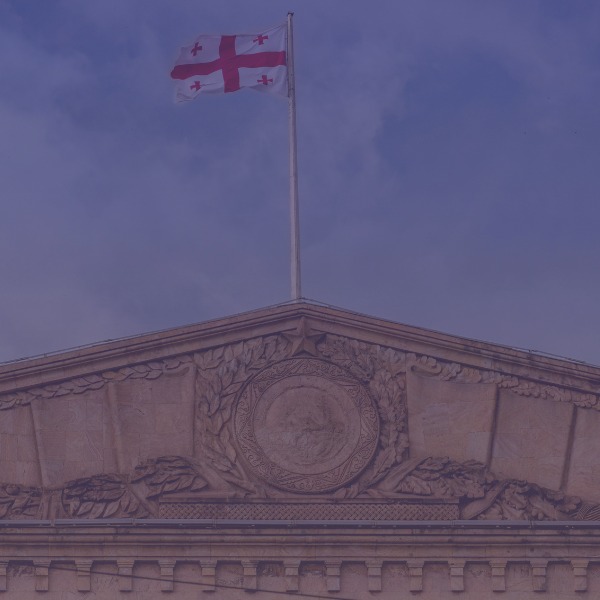
 The End of a Dream: Can International Sanctions Dismantle Authoritarian Rule in Georgia?
 The Digital Monroe Doctrine: rebranding copyright infringement as a military asset
 Transformative Justice in the Syrian Transition
 Strategic Pragmatism: A New Approach to European Engagement in Africa
Written by Karen Apreevi, MA candidate at the Business and Technology University (BTU) Security Studies programme
Edited by Eske Van Liempt
Abstract
In response to Georgia’s political crisis of late 2024 and ongoing democratic backsliding, several Western nations imposed targeted sanctions against ruling party Georgian Dream’s (GD) officials and billionaire founder Bidzina Ivanishvili. The article evaluates whether existing restrictions can meaningfully reverse democratic backsliding in Georgia and reinvigorate the country’s Euro-Atlantic integration. Drawing on an academic literature review of sanctions effectiveness against non-democratic regimes, the analysis characterises Georgia as an emerging personalist autocracy, whose elites can be responsive to a targeted or “smart” sanctioning model. “Smart” sanctions can undermine regimes’ elite appeasement and dissent-suppression capacity without triggering a “rally-around-the-flag” effect, which makes them strategically optimal for sender states. Furthermore, an analysis of the United States’ Specially Designated Nationals (SDN) framework concludes that despite a robust legal framework consisting of aggregation, extraterritoriality, and secondary sanctions principles, critical vulnerabilities such as the issuance of enabling general licenses, lack of cooperation between major sanctioning authorities (US, UK, and the European Union), and delayed action can jeopardise sanctions impact against the GD. In order to maximise impact, the Western coalition must close legal loopholes, coordinate restrictions, and target selection in the time window before full authoritarian consolidation in Georgia.
Keywords: International sanctions, sanctions effectiveness, autocracy, smart sanctions, Georgian Dream
Georgia in Turmoil
Georgia has been in a deep political crisis since late 2024, following the October Parliamentary elections, which local and international observers criticised for widespread procedural violations (Office for Democratic Institutions and Human Rights, 2024). The government’s subsequent suspension of EU integration until 2028 only amplified public discontent (Civil Georgia, 2024b). The ensuing protest demonstrations have been violently dispersed, leading to detentions, imprisonment, and heavy fines targeting activists, journalists, and opposition politicians (Transparency International Georgia, 2025a). In response to the crackdown, the United States, the United Kingdom, Ukraine, the Baltic states, the Czech Republic, and Germany imposed personal sanctions on officials of the ruling Georgian Dream (GD) party, the Ministry of Internal Affairs (MIA), the judiciary, pro- governmental media personalities, and entrepreneurs (Transparency International Georgia, 2025b). Sanctions involved travel bans and asset freezes, though the latter were applied in only a minority of cases. The European Union agreed to suspend visa-free entry for holders of diplomatic passports (Council of the European Union, 2025). GD’s founder and honorary chair, Bidzina Ivanishvili, remains the most high-profile person sanctioned. This article examines the academic literature on the effectiveness of sanctions against non- democratic regimes. For this analysis, effectiveness is determined by whether or not sanctions can compel the Georgian government to reverse democratic backsliding and return the country to its Euro-Atlantic path. Using the United States’ sanctions architecture as a case study, the article reviews current restrictions and analyses ways in which the international community can leverage them against the GD most effectively.
Sanctions: Effective or Useless
According to the critical literature review by Peksen (2019), the effectiveness of economic or financial sanctions can be examined from two primary perspectives – those of the sanctioning (sending) and sanctioned (target) states. The sender-based school of thought holds that effective sanctions generally require inflicting (or threatening) substantial damage on the target by weaponizing the target’s political and economic ties to the sender (Peksen, 2019). However, such pressure may be ineffective if the target can bypass sanctions, either through alternative trade partners or illicit channels (von Soest, 2023). To limit circumvention possibilities, sanctions can be imposed by a coalition of states or international organizations (e.g., the United Nations and the European Union are considered more effective (Peksen, 2019). Likewise, the effectiveness of sanctions in the Georgian context will likely depend on the sender states’ ability to sufficiently pressure the GD, while also restricting circumvention options. The target-based school of thought, on the other hand, assumes that the outcomes of sanctions depend on the target state’s political system. Two crucial factors influencing compliance are the leadership’s ability to (1) shield their elites from the adverse effects of restrictions and (2) suppress dissent among the population (Peksen, 2019). Given limited public accountability, non-democratic regimes are expected to be less compliant than democracies when sanctioned (Zarpli, 2022). Autocracies can divert tax or trade revenues to reimburse the elites’ financial losses without public scrutiny. Meanwhile, the loyal security apparatus suppresses popular dissent (Zarpli, 2022). However, different types of autocracies manage the effects of sanctions with varying degrees of success. For instance, personalist autocracies might be more vulnerable due to low institutionalization, limiting their opportunities to appease elites and suppress dissent. In addition, dependence on external aid also makes such regimes more likely to concede under pressure (Peksen, 2017). Conversely, single-party or military dictatorships are more resilient since their control over state institutions and the public is more entrenched (Peksen, 2017). Within this framework, Georgia can be characterised as an emerging personalist autocracy, given the informal leadership of Mr. Ivanishvili and the ongoing democratic backsliding (Zedelashvili et al., 2025). For sanctions senders, this means that Georgian elites can be vulnerable to economic pressure, even though the possibility of regime transformation towards a more institutionalised autocracy can diminish the effect of sanctions. The literature also distinguishes between comprehensive and targeted or “smart” sanctions (Drezner, 2022). Comprehensive sanctions, such as trade embargoes, target the nation’s economy as a whole, while “smart” sanctions only pressure public officials and regime loyalists such as media personalities, entrepreneurs, etc. (von Soest, 2023). The GD and its associates have thus far been exposed to targeted travel and financial sanctions, which are generally considered more effective against autocracies (Peksen, 2019). This assumption rests on the fact that affected individuals or groups possess influence over state policies and, thus, can lobby for their amendment if pressured by sanctions (von Soest, 2023). The second reason relates to narrative control in authoritarian regimes (Grauvogel & Von Soest, 2014). Since comprehensive sanctions (such as trade embargoes) can cause standards of living to decline, the authorities can frame them as an attack against the nation and consolidate public support against the sanctions senders (Drezner, 2022). By sidestepping domestic pressure in such a way, autocrats can minimise the effectiveness of sanctions (Grauvogel & Von Soest, 2014). In contrast, smart sanctions are less susceptible to such framing due to their limited scope.
Sanctions and Elite Appeasement
Although the overall evidence does not indicate a systematic effort, so far there have been several attempts by the Georgian public authorities to reward the sanctioned officials for their loyalty (Civil Georgia, 2025). In one instance, the Prime Minister Irakli Kobakhidze promoted Vakhtang Gomelauri, then Minister of Internal Affairs (MIA), to one of his Deputies (Civil Georgia, 2024e). President Mikheil Kavelashvili awarded Gomelauri and his colleague Zviad Kharazishvili, the head of the “riot police”, with the Order of Honour (Civil Georgia, 2025). While authorities have extensively shielded law enforcement from allegations of brutality (Civil Georgia, 2024d), both Gomelauri and Kharazishvili resigned from their MIA posts months after being sanctioned by the United States and the United Kingdom. Despite the scarcity of evidence, restrictions can potentially affect GD’s elite appeasement capacity. In Georgia’s case, this capacity largely rests on Bidzina Ivanishvili, sanctioned by the US in December 2024 (U.S. Embassy in Georgia, 2024). Ivanishvili is the wealthiest person in the country, with a net worth of 2.7 billion USD (Forbes, 2025). Local and international human rights watchdogs have been criticising him for exercising informal control over the government by placing close associates in key positions (Transparency International Georgia, 2020). Allegations also underscore his supposed direction of the MIA response to the 2024 anti-government demonstrations (Civil Georgia, 2024c). Utilising the “smart” approach to sanctions, thus making Ivanishvili’s personal and family assets the primary targets of restrictions, could undermine his credibility among the GD loyalists as the guarantor of wealth and privileges. Without sufficient resources to buy or reward loyalty, Ivanishvili may struggle to protect his support coalition from external pressure, contributing to the effectiveness of sanctions (von Soest, 2023). The US’ Specially Designated Nationals (SDN) restrictions well illustrate the opportunities and limitations of sanctions against Ivanishvili and the GD. Administered by the Office of Foreign Assets Control (OFAC), SDN sanctions freeze the US-based assets of targeted individuals or businesses and deny access to the American financial system, including third- party transactions in US dollars, severely restricting Ivanishvili’s capacity to support his elites. Targeted individuals also face entry bans under SDN sanctions (Hess, 2024). OFAC can authorise exemptions from certain sanctions regimes by issuing general or specific licences. Aside from these exceptions, non-compliant individuals or enterprises may face fines, criminal prosecution, or sanctions of their own (Hess, 2024). SDN sanctions are particularly effective due to the principles of aggregation and extraterritoriality (Hess, 2024). The aggregation principle allows OFAC to block any enterprise in which a sanctioned individual owns at least 50% of the shares. If several targeted individuals jointly own 50% or more of the shares, the enterprise can still be sanctioned (Hess, 2024). This provides an opportunity to increase pressure on Ivanishvili by extending sanctions to the companies he co-owns or will own in the future. But so far, a general licence exempts Ivanishvili’s businesses from this rule, only banning business with his person (Office of Foreign Assets Control, 2024). OFAC generally warns against engaging with enterprises connected to sanctioned persons, since restrictions may always be extended to the former (Office of Foreign Assets Control, 2020). However, the leeway created by the general licence likely allowed Ivanishvili to transfer ownership of his assets from offshore companies in Belize and Panama to associated Georgian enterprises (Transparency International, 2025e). Similarly, the absence of British sanctions against Ivanishvili reveals another weakness, as major assets rest in the UK overseas territories, which also act as offshore jurisdictions (Transparency International Georgia, 2025f). These cases demonstrate why an effective sanctions architecture must seal legal loopholes and have broad multilateral support. Neither condition is fully met for the GD-related restrictions at the moment, jeopardizing effectiveness. Together with aggregation, extraterritoriality is another integral feature of all US sanctions, including those enacted against the GD representatives. It allows the enforcement of US restrictions overseas, banning any individual or entity with legal ties (so-called “nexus”) to the US from transacting with Ivanishvili. The US nexus is present where US nationals, companies, financial systems, or institutions are involved in a transaction, regardless of its location (Hess, 2024). Another available measure not yet implemented in the Georgian context is “secondary sanctions”. The purpose of secondary sanctions is to deter third countries or entities from bypassing US restrictions (Hood et al., 2025). Under the US framework, secondary sanctions can be authorised through Presidential Executive Orders (EOs) or congressional legislation (Hess, 2024). Ivanishvili himself was subject to secondary sanctions under EO 14024, originally issued in 2021 to combat Russian “harmful foreign activities”, including democratic backsliding (Executive Order 14024, 2021). The press statement from the Department of State explicitly implicates Ivanishvili in “undermining the democratic and Euro-Atlantic future of Georgia for the benefit of the Russian Federation” (US Embassy in Georgia, 2024). While the statement does not mention “secondary sanctions” directly, EO 14024 effectively authorises them with two provisions. First, it targets any non- Russian individual or entity facilitating these “harmful activities” abroad. Second, the EO also allows sanctions against those who assist the designated (Executive Order 14024, 2021). This means that actors engaging with or supporting Ivanishvili are also at risk of secondary sanctions. Such a risk increases the impact of sanctions, as it generally incentivises third countries to follow US restrictions even without imposing their own (Bartlett & Ophel, 2021). However, enforcement in such cases can be inconsistent and sometimes favourable to the sanctioned. A telling case is how the Swiss bank Julius Baer and the compliance authorities of Belize and Panama chose to interpret US sanctions. The former took pre-emptive action, freezing not only Ivanishvili’s account but also those of his family members, who are not yet under sanctions (Georgia Today, 2025). Meanwhile, the latter have not blocked asset restructuring, likely because they were performed by Ivanishvili-related enterprises that are exempt from sanctions. Inconsistencies in interpretation could affect the effectiveness of secondary sanctions. Therefore, adopting commensurate UK/EU restrictions is warranted to support the US effort and prevent sanction circumvention.
Sanctions and Dissent Suppression
Governments that can successfully suppress domestic opposition are less likely to concede under sanctions. Autocracies generally upscale repression at home when pressured from abroad (Peksen, 2019). Georgia shows a similar tendency, as the GD has consistently weaponised the security and justice systems to suppress dissent. The actions taken include state-backed violence in the form of protest dispersals and abuse of individual activists (Human Rights Watch, 2024). Some detainees also face inhumane treatment while in custody (Kuenning, 2025). To assess the potential effectiveness of sanctions, one must look at systemic constraints on repressive capacity. In this regard, available evidence suggests that MIA-perpetrated abuse and intimidation tactics are constrained by personnel shortages (Civil Georgia, 2024a). At the peak of protest activity in November-December 2024, the “riot police” would detach units from various parts of the country to handle demonstrations in the capital alone (Civil Georgia, 2024a). Since then, the protests remained consistent but decreased in size and frequency, becoming more manageable for the security apparatus. However, repressive capacity is likely to be constrained if large-scale, geographically dispersed protests reemerge. Another way of suppressing dissent involves prosecution through legal means, which faces far fewer obstacles. Following the opposition’s boycott of parliamentary hearings, Georgian Dream’s Members of Parliament (MPs) have unilaterally adopted legislative amendments criminalising dissent, such as setting administrative detention for blocking the roads during demonstrations (Transparency International Georgia, 2025d). Previously, the same offence only entailed a fine (Transparency International Georgia, 2025c). Detainees are also systematically denied due process and face either bogus or disproportionate charges (Transparency International Georgia, 2025a). Pressure on civil society has also intensified, as charities and non-governmental organisations (NGOs) assisting protesters and detainees had their assets frozen (Gvadzabia, 2025). The prosecution accuses them of inciting and funding violence against the authorities during protests. (Gvadzabia, 2025). Moreover, legislative amendments have also limited freedom of expression, particularly in the media (Transparency International Georgia, 2025c). Together, these measures aim to discourage dissent under threats of legal prosecution or physical harm. While currently capable of imprisoning and abusing its protesters, the GD has so far been unsuccessful at neutralising or marginalising the opposition. The Georgian population remains largely oriented towards the West, limiting the government’s ability to frame sanctions as unjust (National Democratic Institute, 2023). In addition, the security apparatus may fail to manage large, geographically dispersed protests, given the decentralisation of the protest movement in the country. For sanctions to be effective, the sender states need to capitalise on these vulnerabilities before further authoritarian consolidation eliminates them.
Policy statement: from defensive legalism to sovereign reciprocity
Europe must recognise that the US is not merely stating a legal argument about fair use doctrine, but it is establishing who will hold technological hegemony in the upcoming decades. Within this framework, copyright is not perceived as a legal obligation but rather a strategic liability that must be eliminated. Europe’s response must operate at the same level of ambition. Recommendations must reconcile rightsholders’ economic interests and the efforts to boost technological innovation.
First recommendation
The most problematic is the opt-out clause from Article 4(3) since the mechanism places the burden on the individual author. Such is expected to identify use, reserve rights and enforce compliance against some of the most powerful existing companies. Imposing a levy, requiring AI developers to contribute to a collectively managed fund compensating rightsholders, would align incentives without requiring individual enforcement (Buick, 2025).
Second recommendation
There is no agreed technical standard for machine-readable rights reservation, which renders Article 4 CDSM structurally inoperable in practice. The European Commission must require an interoperability standard binding on all general-purpose AI model providers that access the EU market. This directly complements the documentation requirements already imposed by the AI Act: rather than merely advocating for transparency about the extraction of data, a mandatory standard would simultaneously prevent unauthorised and unconsented extraction at the technical level. Transparency without prevention is documentation of harm, not its remedy.
Third recommendation
Access to the EU market must rest on verifiable training data compliance, not self- declaration. Independent audits must function as a sine qua non instrument: providers seeking EU market access should be required to submit externally verified training data summaries before deployment, not after enforcement action. This is the operational extension of Recital 106 of the AI Act’s extraterritorial claim. Market power is Europe’s most effective tool and therefore must be used at the point of entry, not retrospectively.
Conclusion
A Digital Monroe Doctrine is taking shape in Washington and the intentions are simple: American technology companies will train on whatever data they require. Any government that enforces its copyright laws against that practice is engaging in economic aggression.
The risk for Europe is not merely legal. It is existential. If the Brussels Effect is neutralised by regulatory arbitrage and political pressure, European startups face compliance costs that Americans do not. And if the talent that could build a competitive European AI sector continues to migrate West, Europe will not merely lose a trade argument. It will lose the capacity to build its technological sovereignty. Washington has declared that copyright infringement, rebranded as patriotism, is a national security asset. In the midst of this “Digital Cold War”, Europe must be equally clear in response. The rights of creators are not negotiable and the systematic use of creative work without the author’s consent is a political choice, not an expression of technological development.
Bibliography
Abbamonte, G. B. (2024). The application of the copyright TDM exceptions and transparency requirements in the AI Act to the training of generative AI. European Intellectual Property Review, 46(7), 479–487.
Berger, V. (2025, March 17). The Ai Copyright Battle: Why OpenAI and Google are pushing for Fair Use. Forbes. https://www.forbes.com/sites/virginieberger/2025/03/15/the-ai- copyright-battle-why-openai-and-google-are-pushing-for-fair-use/
Buick, A. (2025, December 12). Copyright and AI training data—transparency to the rescue? Journal of Intellectual Property Law & Practice 20(3), 182-192. https://doi.org/10.1093/jiplp/jpae102
Coyle, J. (2023, September 27). In Hollywood writers’ battle against AI, humans win (for now). AP. https://apnews.com/article/hollywood-ai-strike-wga-artificial-intelligence- 39ab72582c3a15f77510c9c30a45ffc8
Ginsburg, J., C (2025, August 4). AI inputs, fair use and the US Copyright Office Report. Journal of Intellectual Property Law & Practice, 20(8). 10.1093/jiplp/jpaf046
Gallagher, W. (2025, June 18). Meta, Amazon, and more want 10-year ban on states regulating AI. Appleinsider. https://appleinsider.com/articles/25/06/18/meta-amazon-and- more-want-10-year-ban-on-states-regulating-ai
Kraus, J. (2026, April 10). White House AI Framework Proposed Industry-Friendly Legislation. Lawfare. https://www.lawfaremedia.org/article/white-house-ai-framework- proposes-industry-friendly-legislation
Daniel, L. (2025, February 14). U.S. court ruling puts AI training practices under the microscope. Forbes. https://www.forbes.com/sites/larsdaniel/2025/02/14/us-court-ruling- puts-ai-training-practices-under-the-microscope/
Lau, R., Tolentino J.J., Lennet B. (2025, December 3). November 2025 US Tech Policy Roundup. Tech Policy. https://www.techpolicy.press/november-2025-us-tech-policy- roundup/
Martin, N. (2025, January 9). Digital taxes put US-EU trade talks under pressure. DW. https://www.dw.com/en/digital-taxes-put-us-eu-trade-talks-under-pressure/a- 73798948
Niestadt, M. (2026, June). Digital Omnibus on AI. European Parliament. https://www.europarl.europa.eu/RegData/etudes/BRIE/2026/782651/EPRS_BRI(202 6)782651_EN.pdf
OpenAi. (2025, March 13). OpenAi’s proposal for the U.S AI Action Plan. OpenAi Global Affairs. https://openai.com/global-affairs/openai-proposals-for-the-us-ai-action-plan/.
Quintais, P., J. (2025, April). Generative AI, copyright and the AI Act. Computer&Law Security Review, 10. https://doi.org/10.1016/j.clsr.2025.106107.
Roeloffs, M. W. (2024, April). Artists Slam Developers For Using Music Without Permission In Letter Signed By Kacey Musgraves, Billie Eilish And More. Forbes. https://www.forbes.com/sites/maryroeloffs/2024/04/02/artists-slam-ai-developers-for-using- music-without-permission-in-letter-signed-by-kacey-musgraves-billie-eilish-and-more/
Rosati, E. (2024, 31 October). Infringing AI: liability for AI-generated outputs under International, EU, and UK Copyright Law. European Journal of Risk Regulation 16(2), 603- 627. https://doi.org/10.1017/err.2024.72
Seetharaman, D., Arámburo F. (2026, February 13). OpenAI says China's DeepSeek trained its AI by distilling US models, memo shows. Reuters. https://www.reuters.com/world/china/openai-accuses-deepseek-distilling-us-models-gain- advantage-bloomberg-news-2026-02-12/
Wiggers, K. (2025) OP. OpenAI calls for US government to codify “fair use” for AI training. Techcrunch. https://techcrunch.com/2025/03/13/openai-calls-for-u-s-government-to-codify- fair-use-for-ai-training/
Ziaja, G.,M. (2024). The text and data mining opt-out in Article 4(3) CDSDM: Adequate veto right for rightholders or suffocating blanket for European artificial intelligence innovation? Journal of Intellectual Property Law, 19(5), 453-459. https://doi.org/10.1093/jiplp/jpae025
Moderate use of AI models: yes/no – language editing and source consultation