
 The Digital Monroe Doctrine: rebranding copyright infringement as a military asset
  Transformative Justice in the Syrian Transition
  Strategic Pragmatism: A New Approach to European Engagement in Africa
  Special Issue “Role of AI and Automated Decision-Making Systems in Asylum and Migration”
Written by Malena Carpico
Introduction
France, like Germany, is widely considered as a founding pillar of the European Union and a driving force behind the development of what is now the European Union. However, successive leaders have not been unanimous in their support for EU policies. Some French leaders, such as Charles de Gaulle, were sceptical of deeper integration and, often, prioritised French national interests over European ones. Others, such as Valéry Giscard d’Estaing or François Mitterrand, embraced the European project and fostered closer relationships with their German counterparts (Touteleurope.eu, 2025).
France’s current president, Emmanuel Macron, has been a major advocate for a stronger and more integrated European Union. Recently, for example, he advocated for reinforcing and expanding the French nuclear umbrella to all European allies (Élysée, 2026). In light of this, it is quite surprising that public opinion towards the EU in France is one of the lowest relative to other member states, having some of the least favourable views on the EU and showing growing euroscepticism (Institut Jaques Delors, 2020). This difference can be observed in the 2024 European Parliament (EP) elections, as the French far-right, populist and Eurosceptic party, the Rassemblement National (RN), won a larger share of the votes than Macron’s Renaissance party. The RN obtained 31% of the votes, while Macron’s party and coalition won 14,5% (European Parliament, 2024). This gap could become a problem for the European Union, since France is one of the biggest economies of the EU. In this context, the election of an EU-sceptic French president could significantly stall further EU integration. Therefore, this brief analyses and explains the gap between French public opinion towards the EU and Macron’s pro-EU agenda, using the 2024 European Parliament elections as a case study.
French Presidents and the EU
Some of Macron’s predecessors are known for their support for the EU and the implementation of policies for an ever-closer union in Europe. A key to understanding the French approach to EU integration is to look at the relationship between French Presidents and German Chancellors throughout the years. The two countries embody the two central drivers of European integration and, yet, have not always shared the same approach towards it. For example, Giscard and Schmidt advocated for closer monetary and budgetary cooperation in the 1970s in order to limit financial instability. In addition, Mitterand and Kolh succeeded in advancing the idea of a single common currency (Touteleurope.eu, 2025). Macron sought to continue this tradition of Franco-German collaboration with Scholz.
Macron has long been a strong supporter of the European Union and one of its main advocates. Together with his German counterpart, he called for stronger European sovereignty for the 60th anniversary of the Elysée Treaty (Le Monde avec AFP, 2023). The call echoed the spirit of the Elysée Treaty, by presenting Franco-German cooperation as central to building a more sovereign Europe. For both leaders, Europe needs to invest more in its defence capabilities and industries in order to build a stronger European pillar within NATO. This collaborative relationship has allowed the two countries to navigate successive crises while demonstrating their commitment to the EU.
A leader who wants Europe to change
While advocating for a stronger and more united Europe, especially on strategic matters, Macron is also quite concerned for and realistic about the institutional and geopolitical challenges currently facing the EU. In fact, he warned that the “EU was “mortal” and “can die” in a speech before the 2024 European Parliament elections (Presidency of the French Republic, 2023). His main concern was Europe’s heavy reliance on the United States for defence and armament procurement. He argued that “the rules of the game had changed” and that Europe risks being weakened by its reliance on other countries while unprepared to face some challenges alone (Presidency of the French Republic, 2023). He described the current state of Europe as “too slow” and “not ambitious” enough, urging instead for a “powerful Europe”(Presidency of the French Republic, 2023). This rhetoric continued during discussions on EU defence spending in 2025, when Macron urged for procurement to be directed predominantly towards European industry (Presidency of the French Republic, 2023).
This commitment to Europe and the European Union has been an important part of Macron’s political convictions since he was first elected in 2017. His speech on the 2024 European elections in April 2024 can be read as a follow-up to his 2017 Sorbonne speech, in which he already urged Europe to strengthen its defence and economic “self-sufficiency” (Elysée, 2017). While he recognised that European armies were unlikely to merge into one single force, Macron called for closer coordination around shared common goals, including the creation of a European military academy (Presidency of the French Republic, 2023). Macron also highlighted the European Union’s recent successes, particularly in terms of unity and sovereignty. Although he acknowledged past and future crises, he presented Brexit as a warning, arguing that leaving the EU could be a costly and damaging choice for a country, pointing out that “nobody really dares to call for an exit from Europe or the Euro anymore” (Presidency of the French Republic, 2023).
The 2024 EP elections
In the 2024 European Parliament (EP) elections in France, the far-right populist party Rassemblement National (National Rally or RN) achieved a high score (31%), winning more than a third of the vote (European Parliament, 2024). The RN is generally defined as a far-right and Eurosceptic party and is aligned with the Patriots for Europe, a group in the European Parliament mainly constituted of other Eurosceptic parties (Ipsos, 2024). Macron’s party came second with around 15% of the votes with a pro-European platform and policy.
Compared with other European countries, French results for the EP elections were not so different. The far right performed strongly as well in Italy, the Netherlands and Belgium (Statistica, 2024). Despite the radical right wing’s progress throughout Europe, the majority of the EP remains broadly pro-EU, meaning that Euroscepticism has not yet affected the EU Parliament. The risk remains, however, as Eurosceptic parties continue to grow and could form coalitions capable of shaping and blocking integration efforts and other key EU policies. These results can be better understood by considering both the parties’ campaign strategies and how French voters typically approach European Parliament elections. First, the rise in Euroscepticism was visible even before the 2024 EP election, as opinion polls clearly indicated that the National Rally, led by Jordan Bardella, was likely to receive a third of the votes. The final result broadly matched the projections. Populist and radical parties, especially on the far right, frequently adopt strong and polarising discourses, which can encourage voting focusing on single, emotionally charged issues rather than considering the party’s overall policy platform. In 2024, inflation, migration and security were key issues mobilising French voters towards the RN, reinforcing the argument that polarised and emotionally-charged issues mobilised voters for the EP elections (Toute L’europe, 2024).
Another way to interpret the EP results is through the lens of “protest voting” driven by several overlapping dynamics (Marsh,Hix, 2007). First, the EP elections can be seen as second- order elections to protest against a national government and their policies (handling of socioeconomic issues, foreign policy or stance on EU integration (Schulte-Cloos, 2018). In addition, they can be a way to “sanction” the incumbent president before the next national election (Schulte-Cloos, 2018). Some voters may have expressed anti-incumbent sentiment towards Macron as a long-serving leader, regardless of his specific policy choices (Le Monde, 2024). However, the vote may have also signalled dissatisfaction with Macron’s party and his policy record, including on salient domestic issues throughout the last presidential mandate. Lastly, the results may also point to broader Euroscepticism and to a widening gap between Macron’s pro-EU agenda and attitudes among the French electorate towards the EU and its institutions.
One indicator of the French electorate’s attitude towards the EU is institutional trust. The Eurobarometer of Spring 2024 results on trust in EU institutions (Image 1.0) indicate that France, although being one of the biggest countries in the EU and one of its founding members, shows the lowest level of trust in EU institutions (Eurobarometer, 2024). In addition, the dissatisfaction is higher than the rest of the European Union, with more than 10 percentage points more than the general EU citizens (27% compared to 17%) (European Parliament, 2024) as shown in the same study as image.1.
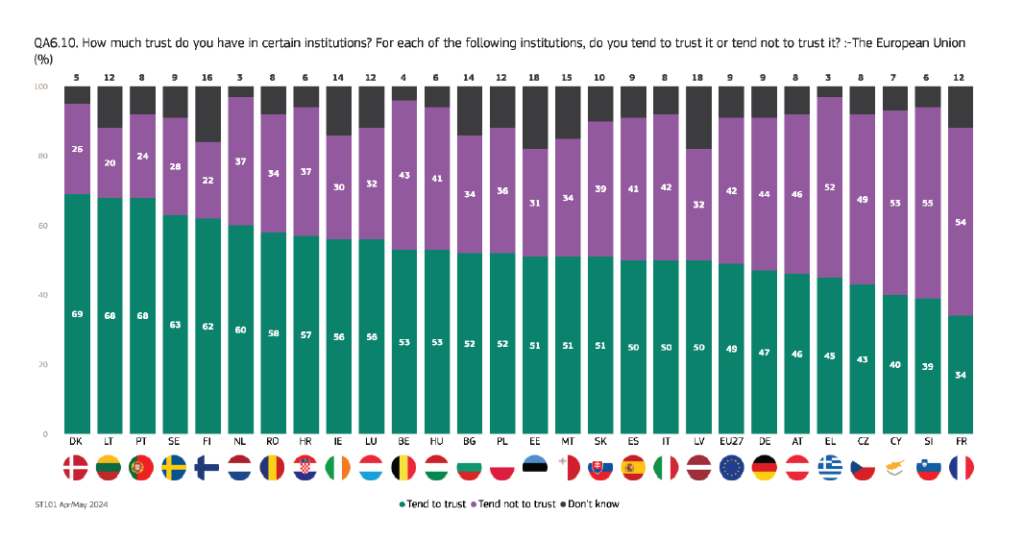
Image 1.0; trust in EU institutions according to the country.
Eurobarometer Standard 101 – Spring 2024 – Public opinion in the EU_en.pdf.pdf
Another defining feature of EP elections in France is low turnout, often below 50%. In 2024, the turnout was higher than in previous elections, with more than 50% of the population voting. Although the turnout was higher compared to previous elections, it still only represented half of the population (European Parliament, 2024). Throughout the years, the EP has been struggling to achieve high turnout at its elections. As shown in Image 1.2, French citizens are still slightly less interested in voting for the EP elections than most European citizens. This disengagement for the European Parliament can be explained through different hypotheses, such as a lack of identification with the EP, a lack of knowledge of the EU and its political processes, and a lack of effort in campaigning from the national parties (Clark, 2014; Cordis EU research result, 2008).
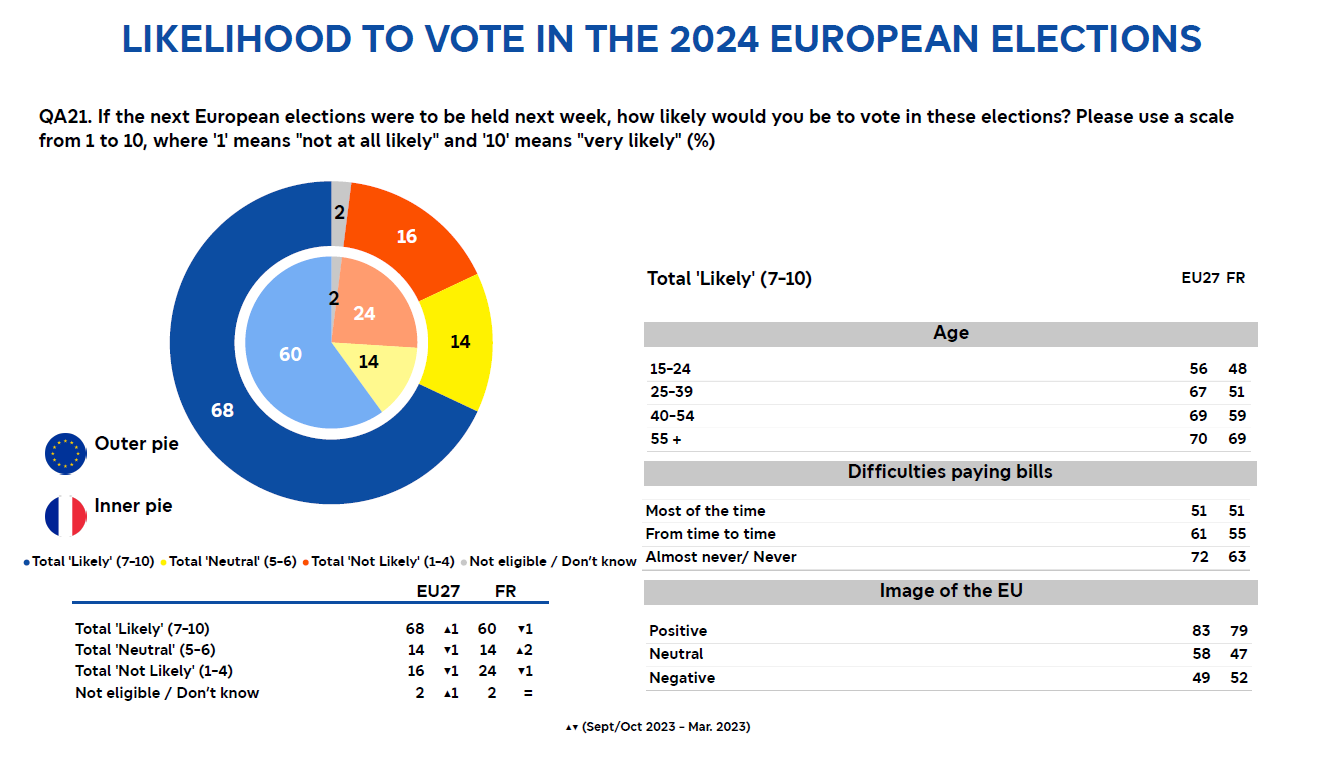
Image 1.2; likelihood to vote in the 2024 European elections
It is worth noting that, despite being low, the turnout for EP elections in France has been higher since 2019, suggesting that French voters may increasingly view these elections as less “second-order” than in the past, raising slightly more than 1% (European Parliament, 2024). This slight increase in French interest at the EU level could signal a shift in the French political landscape, including the emergence of European integration as a key issue in French political culture.
Regardless of lower turnouts, the results of the EP elections are often used to anticipate future national elections. Thus, as France prepares for its next presidential election in 2027, a question arises: what would the election of a Eurosceptic French president mean for France and the EU? (Le Monde, 2024)
What an Eurosceptic President could mean for the EU
An important thing to highlight here is the difference in Euroscepticism. In the context of France, it will be talking about soft euroscepticism as the RN’s policies differ from “traditional” hard euroscepticism supporting leaving the EU. The RN focuses more on specific policies within the EU and mobilizing a distrust and dissatisfaction with the EU structure and some policies such as migration, sovereignty and economic policies (Public Sénat, 2024). If France had already shown some dissatisfaction towards the EU such as the rejection of the 2005 Constitutional Treaty referendum, the role of the RN is different now, capitalizing rather on the hope to change the EU from the inside. However, recently, with the local elections held in March 2026, numerous new RN mayors have been elected and started taking down the European flags from the city councils, an act that could indicate a change in their policies and beliefs (Le Monde, 2026).
After the 2024 European Parliament election results, Macron called snap legislative elections. At this point, the whole EU was concerned about the implications of a possible far-right and anti-EU parliamentary majority in France. As France and Germany are often described as the “engine” of European integration, there were fears that political paralysis in either of the two countries could complicate EU decision-making and further integration (Blenkinso, Gray, Rose, 2024). The Eurosceptic Hungarian Prime Minister Victor Orban has, for example, blocked numerous votes to aid Ukraine, rejected Qualified Majority Voting amendments to the EU system, and affected EU’s credibility by adopting a different foreign policy stance than the bloc’s leaders. Macron, on the other hand, has been portrayed as a leading advocate of a stronger, more independent and assertive European Union, especially since the election of Donald Trump (Caulcutt, Moens, Vinocur, 2024). In this context, pro-EU leadership from the French presidency is often regarded as important and necessary for forging an ever-closer union.
Moreover, data suggests that public opinion towards the EU in France fluctuates according to the level and quality of support for the European Union from the French president. A Eurosceptic French president could therefore shape public opinion and further worsen trust in EU institutions (Vassallo, 2012). For example, during the 2012 presidential election in France, both leading candidates adopted a “EU-negative” tone, by criticising the EU and its policies. In the context where trust and satisfaction concerning the EU in France were not very strong (Eurobarometer, 2012), there are fears that adopting a EU-negative stance can be strategic to win a presidential election in France again, as in 2012 with François Hollande’s election.
The 2024 French legislative snap elections also suggest that a strong performance in the EP elections does not necessarily predict national outcomes.During those elections, a coalition of left parties arose to counter the far-right parties, avoiding a majority of far-right elected representatives and so, the outcome of a far-right Prime Minister. A united left proved to be an effective obstacle for the far-right populist party access to power (Le Monde, 2024).Thus, the legislative elections proved a window of hope for progressive and pro-EU parties in France.
More generally, analysis suggests the time gap between an EP election and a national presidential election affects whether a party that performed well at the European level will do so too at the national level. If the distance between an EP election and a presidential national one is larger, radical populist parties tend to gain less from a high performance at the European level (around 0,3%, compared to around 0,8% when elections are less than a year apart) (Schulte- Cloos, 2018).Thus, 3 years until the 2027 presidential elections in France offer the possibility that an RN victory at the European level does not automatically transform into an equally high score at the national level (Schulte-Cloos, 2018). The results of the RN, nevertheless, still remain a challenge for the other French political parties, which will have to coordinate a successful electoral campaign, succeed in capitalising on main issues like the RN, or be able to form a strong coalition to convince voters away from the far-right. Without credible and united alternatives around polarising and emotionally-charged issues, the RN’s appeal may remain resilient.
Conclusion
To conclude, Macron is considered a strong leader of the European Union on the international scene, advocating for a stronger and more resilient EU, aiming to stop relying on other countries such as China or the US. On the other hand, the French public portrays a growing distrust in EU institutions, having one of the lowest in the EU. During the 2024 European Parliament elections, one third of votes were cast in favour of the populist far-right and Eurosceptic National Rally party. This gap between public opinion and the leader of one of the motors of the EU can be a danger for the Union. The European Parliament elections have been depicted as “second-order” elections, and a way to protest against the current leader, partially explaining the low percentage of votes for Macron’s party. This means that the victory of the RN could not automatically translate into a victory in the next French Presidential elections, scheduled for 2027. However, the next elections in France will be closely watched by the international and European leaders, as the new French leader will strongly influence France’s European path, European politics, integration and the future of the Union.
BIBLIOGRAPHY:
Clark, N. (2014). Explaining low turnout in European elections: The role of issue salience and institutional perceptions in elections to the European Parliament. Journal of European Integration, 36(4), 339–356. https://doi.org/10.1080/07036337.2013.841680
CORDIS. (n.d.). Increasing turnout at European elections. European Commission. Retrieved November 20, 2024, from https://cordis.europa.eu/article/id/29355-increasing-turnout-at- european-elections
Élysée. (2017, September 26). President Macron gives speech on new initiative for Europe. https://www.elysee.fr/en/emmanuel-macron/2017/09/26/president-macron-gives-speech-on- new-initiative-for-europe
Élysée. (2023, January 22). French-German declaration. https://www.elysee.fr/en/emmanuel- macron/2023/01/22/french-german-declaration
Élysée. (2026, March 2). Joint declaration of President Macron and Chancellor Merz. https://www.elysee.fr/en/emmanuel-macron/2026/03/02/joint-declaration-of-president-macron- and-chancellor-merz
European Parliament. (2019). Euroflections: European Parliament elections 2019. https://www.europarl.europa.eu/euroflections-ep-elections-2019
European Parliament. (2023, December). EP autumn 2023 survey: Six months before the 2024 European elections (Eurobarometer). https://www.europarl.europa.eu/ep-autumn-survey-2023
European Parliament. (2024). EP spring 2024 EB045EP factsheet. https://www.europarl.europa.eu/ep-spring-2024-factsheet
European Parliament. (2024). Post-electoral survey 2024: Factsheet. https://www.europarl.europa.eu/ep-post-electoral-2024-factsheet
European Parliament. (n.d.). 2024 spring Eurobarometer – First results. https://www.europarl.europa.eu/eb-first-results-2024
European Parliament. (n.d.). European election results – Turnout. https://results.elections.europa.eu/en/turnout/
European Parliament. (2024). Résultats des élections européennes 2024 – France. https://results.elections.europa.eu/fr/outils/widget-pays/france/2024-2029/
Institut Jacques Delors. (n.d.). Les Français et l’Europe: Entre défiance et ambivalence. https://institutdelors.eu/en/publications/les-francais-et-leurope-entre-defiance-et-ambivalence-2/
Ipsos. (n.d.). Européennes 2024: Intentions de vote et chiffres clés. https://www.ipsos- europeennes-2024-intention-vote
Le Monde. (2024). Elections européennes 2024: Le camp Macron gagné par le doute. https://www.lemonde.fr/2024-elections-macron
Le Monde.(2026).Des maires RN nouvellement élus retirent le drapeau européen de leur hôtel de ville Des maires RN nouvellement élus retirent le drapeau européen de leur hôtel de ville
Politico. (n.d.). Europe risks dying and faces big decisions – Macron. https://www.politico.eu/europe-risks-dying
Politico. (n.d.). In EU speech, Macron says Europe is “mortal” and “can die”. https://www.politico.eu/macron-europe-mortal-can-die
Politico. (n.d.). Macron to Europe: We need to become “omnivores” after Trump’s victory. https://www.politico.eu/macron-omnivores-trump-victory
Public Senat(2024). Frexit : “On ne va pas quitter la table de jeu européenne alors qu’on est en train de gagner la partie”, explique un eurodéputé RN Frexit : “On ne va pas quitter la table de jeu européenne alors qu’on est en train de gagner la partie”, explique un eurodéputé RN
Reuters. (n.d.). French election: Macron’s gamble raises stakes for Europe’s future. https://www.reuters.com/macron-gamble-europe
Schulte-Cloos, J. (2018). Do European Parliament elections foster challenger parties’ success on the national level? European Union Politics, 19(3), 408–426. https://doi.org/10.1177/1465116518773486
Statista. (2024). Seats won in the European Parliament elections 2024, by country and party. https://www.statista.com/statistics/1472642/seats-won-european-parliament-country-party/
Toute l’Europe. (2024). Elections européennes 2024: Programme de Jordan Bardella et du Rassemblement national. https://www.touteleurope.eu/vie-politique-des-etats- membres/elections-europeennes-2024-le-programme-de-jordan-bardella-et-du-rassemblement- national-rn/
Toute l’Europe. (2024). Elections européennes 2024: Le RN creuse l’écart avec le camp présidentiel. https://www.touteleurope.eu/2024-elections-rn
Toute l’Europe. (2024). Elections européennes 2024: Les partis europhiles résistent à la progression de la droite radicale. https://www.touteleurope.eu/2024-elections-europhiles
Toute l’Europe. (n.d.). Les personnalités historiques de l’Union européenne. https://www.touteleurope.eu/personnalites-historiques-ue
Vassallo, F. (2012). The EU discourse in the 2012 French presidential election. French Politics, Culture & Society, 30(3), 79–95. http://www.jstor.org/stable/42843766